
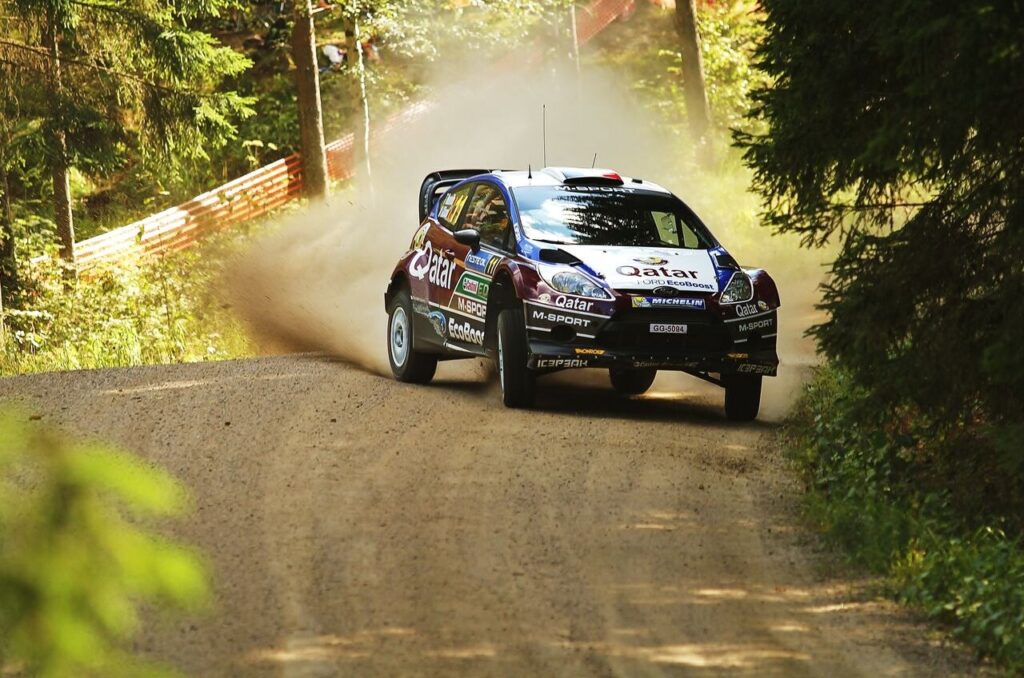
 Photo: maksimaalinen atakki, Public domain, Wikimedia Commons
Ford’s World Rally Car for the 1.6 turbo era from 2011 to 2016, developed from the Fiesta S2000. It won six WRC rounds in 2011 and 2012, and its RRC variant with a 30 mm restrictor won 14 WRC-2 rounds.
| Class | World Rally Car (2011 to 2016 regulations); RRC variant for regional championships |
|---|---|
| Built by | M-Sport and Ford Europe, Cockermouth (UK); engine by Pipo Moteurs until 2015, then M-Sport |
| Years | 2011 to 2016 |
| Power | 300 hp |
| Drive | 4WD |
| Gearbox | M-Sport/Xtrac six-speed sequential (mechanical shift at launch, hydraulic shift later), M-Sport/AP Racing twin-disc clutch |
| Weight | 1200 kg |
History
Developed from the Fiesta S2000 for the 2011 WRC rules, which are based on Super 2000 but use a 1.6 litre turbocharged engine. A 2.0 Focus WRC engine was tested in an S2000 car in March 2010 and a 1.6 turbo prototype in August 2010, with over 11,000 km of testing in total.
The car debuted at Rally Sweden 2011 and won on debut with Mikko Hirvonen. Further wins came with Hirvonen, Jari-Matti Latvala and Mads Ostberg, six in total in 2011 and 2012.
In 2012 M-Sport launched the Fiesta RRC for FIA regional rallies, with an S2000 rear wing, different front bumper, lighter flywheel and 30 mm restrictor; it can be converted to WRC spec in about six hours.
Ford withdrew most works support for 2013 and the car did not win again in the WRC, although Thierry Neuville was 2013 championship runner-up in an M-Sport car. A facelift came at Rally Finland 2014, and an Evolution version with an M-Sport-built engine and redesigned cooling, transmission, electronics and differentials arrived before Rally Portugal 2015.
The car was replaced by the Fiesta WRC in 2017; some private owners still enter it in rallies.
Technical specifications
| Engine | Ford 1.6 EcoBoost inline 4, 16 valves, turbocharged, direct injection; Cosworth engine management |
|---|---|
| Power | 300 hp |
| Induction | turbo |
| Turbo restrictor | 33 mm |
| Gearbox | M-Sport/Xtrac six-speed sequential (mechanical shift at launch, hydraulic shift later), M-Sport/AP Racing twin-disc clutch |
| Drive | 4WD |
| Differential | Mechanical front and rear differentials, clutch disconnect on handbrake |
| Suspension | MacPherson struts, Reiger external-reservoir dampers adjustable bump and rebound, adjustable steel links, machined aluminium uprights |
| Brakes (tarmac) | Brembo ventilated discs, four-piston monoblock calipers |
| Brakes (gravel) | Brembo ventilated discs, four-piston monoblock calipers |
| Weight | 1200 kg |
| Length | 3963 mm |
| Width | 1820 mm |
| Wheels | 7 x 15 in aluminium (gravel and snow), 8 x 18 in aluminium (asphalt) |
| Other details | Garrett turbo. Wheelbase 2,480 mm. RRC version: 30 mm restrictor. Torque given by Autoblog as 331 lb-ft (about 449 Nm), unverified. |
Compare with…
Photos
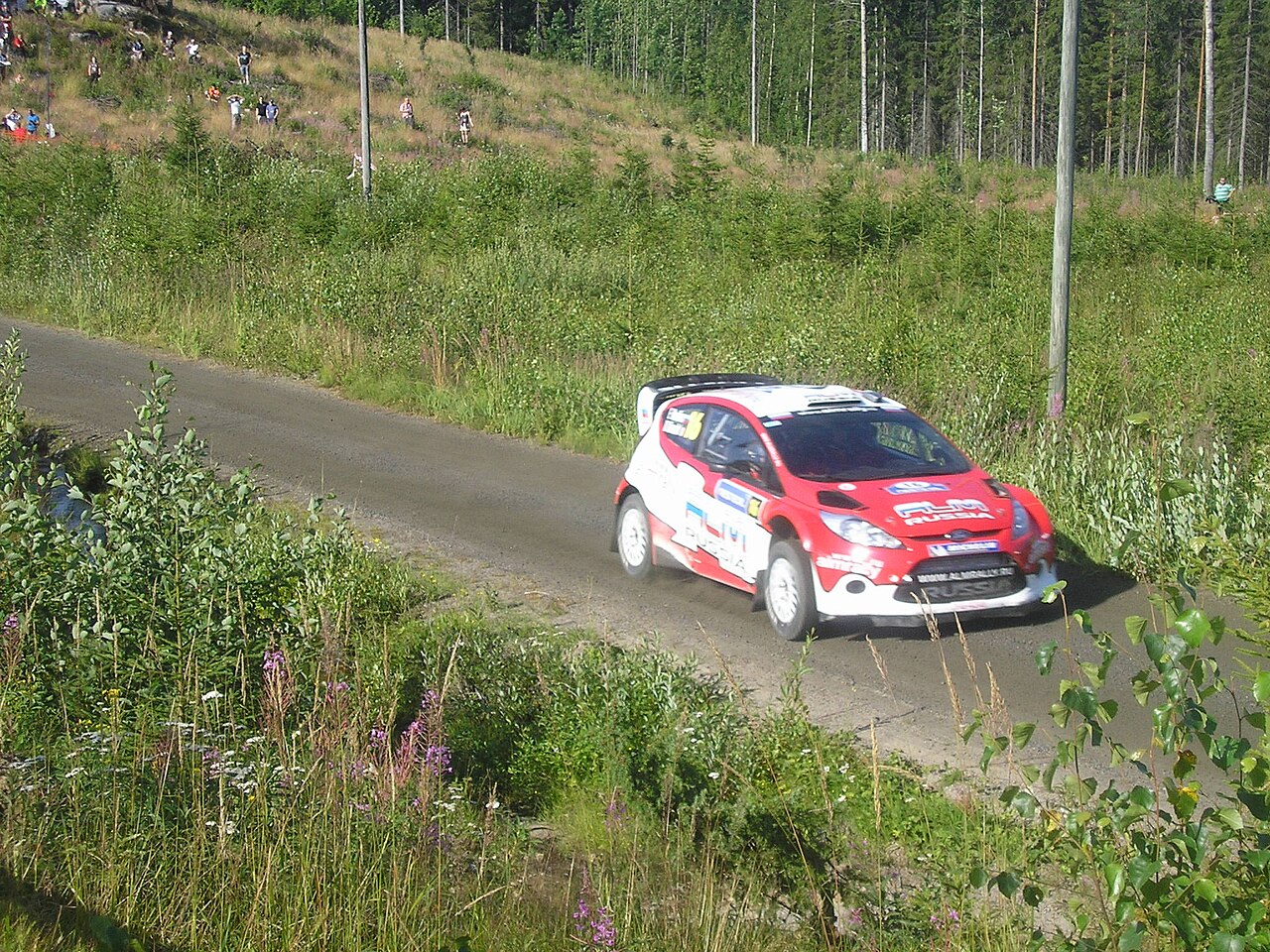 Front
Photo: front Antti Leppänen (CC BY-SA 3.0), via Wikimedia Commons
Homologation
Homologated in early 2011, with a facelift in 2014 and an Evolution version in 2015.
Championships and results
| Year | Championship | Driver | Result |
|---|---|---|---|
| 2011 | WRC | Mikko Hirvonen; Jari-Matti Latvala | wins: Sweden, Australia (Hirvonen), Wales Rally GB (Latvala) |
| 2012 | WRC | Jari-Matti Latvala; Mads Ostberg | wins: Sweden, Wales Rally GB (Latvala), Portugal (Ostberg) |
| 2012 to 2016 | WRC-2 | various (Fiesta RRC) | 14 wins |
Parts and buying advice
Parts that change hands most
- Xtrac six-speed gearbox
- Reiger dampers
- Brembo brakes
- Turbo and engine (Pipo or M-Sport built)
What to check when you buy
- WRC or RRC spec (restrictor 33 or 30 mm)
- Original, facelift 2014 or Evolution 2015 spec
- Engine and gearbox hours
- Chassis provenance and homologation status
Interchangeability
The RRC can be converted to WRC spec in about six hours.
Known suppliers
- Xtrac (gearbox)
- Reiger (dampers)
- Brembo (brakes)
- Garrett (turbo)
- Cosworth (electronics)
- Pipo Moteurs (engine to 2015)
- AP Racing (clutch)
Looking for parts for this car, or selling them?