
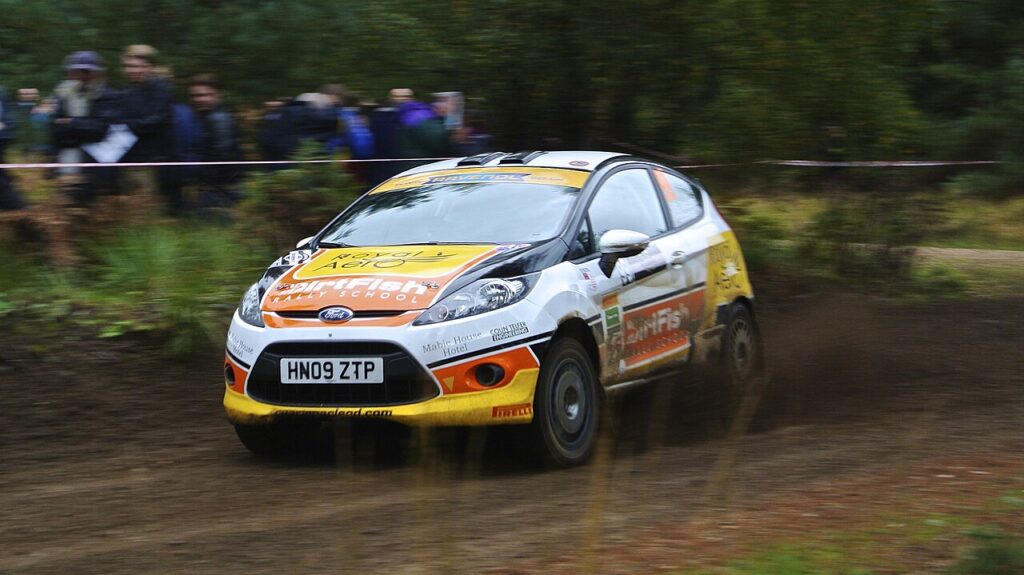
 Photo: Ian Kirk from Broadstone, Dorset, UK, CC BY 2.0, Wikimedia Commons
Front-wheel-drive Group R2 rally car developed by M-Sport on the 2008 to 2017 generation Ford Fiesta, with a naturally aspirated 1.6 Ti-VCT engine and a Sadev five-speed sequential gearbox. It was sold as a conversion kit that kept many standard Ford parts to control cost, and it replaced the Fiesta ST as Ford’s two-wheel-drive entry car.
| Class | Group R2 (naturally aspirated 1.6). Under the 2020 FIA Rally Pyramid, R2 cars map to the Rally4 tier; current eligibility of the 1.6 car depends on national rules and homologation validity. |
|---|---|
| Built by | M-Sport, Dovenby Hall, Cockermouth (UK); built from an M-Sport conversion kit on a Ford Fiesta road car |
| Years | 2009 to 2015 (succeeded by the 1.0 EcoBoost Fiesta R2, homologated 1 May 2015) |
| Power | 163 hp at 7500 rpm |
| Drive | FWD |
| Gearbox | Sadev five-speed sequential, uprated driveshafts, Pi ECU with flat-shift |
| Weight | 1030 kg |
History
M-Sport unveiled the Fiesta R2 at Rally d’Italia Sardegna in June 2009, with homologation proposed for 1 July 2009. It replaced the Group N Fiesta ST and used engineering knowledge from the Focus RS WRC programme.
The car was built from an M-Sport conversion kit, available from M-Sport or appointed national sales outlets. The kit contained engine internals (pistons, conrods, camshafts, valve springs, injectors, airbox, sump baffle), the Sadev sequential gearbox with limited slip differential, uprated brakes and Reiger suspension. Many standard Ford road car parts were retained to reduce cost.
Together with the Fiesta S2000 announced a month earlier, M-Sport presented the R2 as the first step of a ladder from national rallying towards the WRC.
By 2015 M-Sport said the 1.6 Fiesta R2 had sold close to 300 cars in 27 countries. It was then succeeded by the 1.0 litre EcoBoost Fiesta R2 (often called R2T), homologated on 1 May 2015 as an evolution of the 1.6 car.
Technical specifications
| Engine | Ford 1.6 Zetec 16V Ti-VCT (Duratec family), inline 4, DOHC, alloy head and block, variable cam timing |
|---|---|
| Displacement | 1598 cc |
| Power | 163 hp at 7500 rpm |
| Torque | 182 Nm |
| Induction | NA |
| Gearbox | Sadev five-speed sequential, uprated driveshafts, Pi ECU with flat-shift |
| Drive | FWD |
| Differential | Plated limited slip differential |
| Suspension | Reiger adjustable dampers with Eibach springs, spherical-jointed top mounts front and rear, front dampers adjustable bump and rebound, standard rear beam with uprated mounts |
| Brakes (tarmac) | Front 310 mm AP ventilated discs, four-piston calipers; rear 280 mm AP ventilated discs, single-piston calipers; hydraulic handbrake |
| Brakes (gravel) | Front 285 mm AP ventilated discs, four-piston calipers; rear 280 mm AP ventilated discs, single-piston calipers |
| Weight | 1030 kg |
| Other details | 163 PS at 7,500 rpm and 182 Nm at 5,700 rpm (2009 launch specification). |
Photos
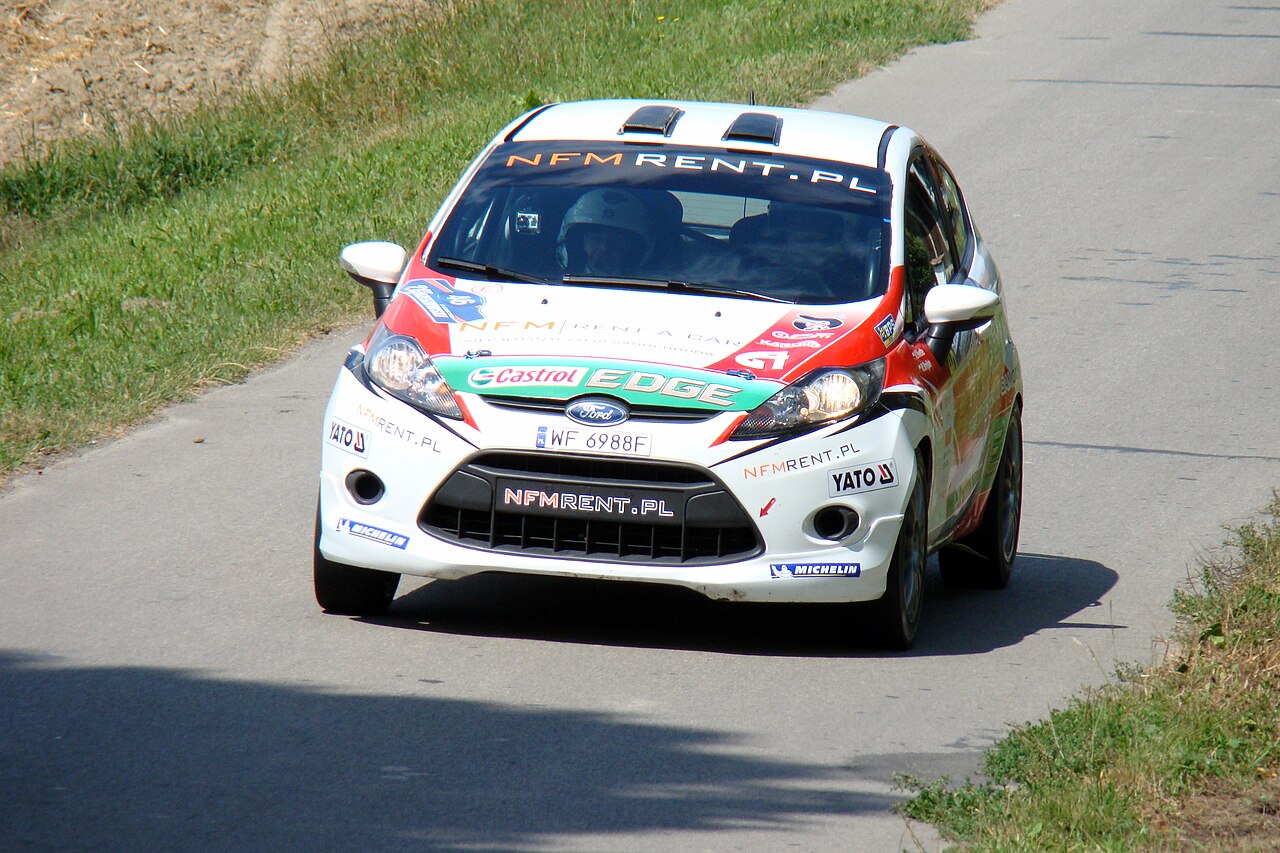 Front
Photo: front Marek Starzyński (CC BY 2.0), via Wikimedia Commons
Homologation
Homologated on 1 July 2009 (planned).
Parts and buying advice
Parts that change hands most
- Sadev five-speed sequential gearbox and plated LSD
- Reiger dampers and Eibach springs
- AP brake discs and calipers
- Engine internals from the M-Sport kit (pistons, conrods, camshafts)
What to check when you buy
- Gearbox and engine hours since last rebuild
- Homologation papers and FIA/national technical passport
- Whether the car is a genuine M-Sport kit build
- Rollcage certification and age
Interchangeability
Many standard Ford Fiesta road car parts were retained in the kit. Interchangeability with the 1.0 EcoBoost R2 should be checked part by part.
Known suppliers
- Sadev (gearbox)
- Reiger (dampers)
- Eibach (springs)
- AP Racing (brakes)
- Pi (ECU)
Looking for parts for this car, or selling them?